Solving leakage in Changbai timber
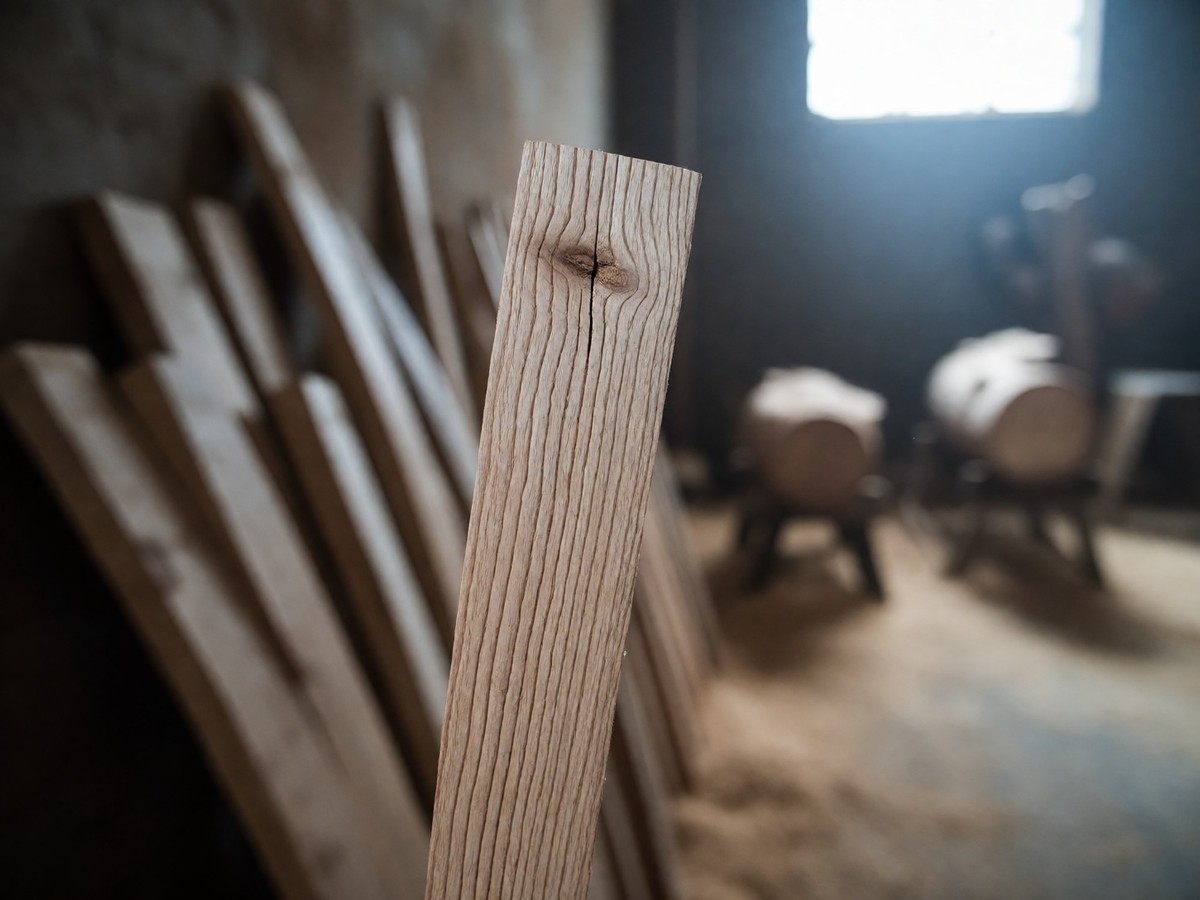
Wolin Cooperage in Shandong Province and Chuan Distillery, owned by Pernod Ricard, address the leakage issues of Chinese oak by using narrow staves. Chinese oak (Quercus mongolica) from the Changbai Mountains grows slowly and often contains twists, knots, cracks, and wormholes. Because the low number of tyloses in Chinese oak makes traditional quarter-sawing or rift-sawing commercially unviable, coopers use narrow staves to block leakage channels and rely on expansion pressure to seal the joints as the spirit penetrates the wood. These staves measure between 7/8 inch and just over an inch wide, similar to the width of a white piano key. A 220-liter piano cask contains more than 75 staves, whereas a conventional barrel holds around 30. These skinny staves cut off more of the leakage channels that traverse from the inner surface of the stave to the outer surface. The ability to hold liquid depends less on the properties of the oak and more on how the cask is assembled.
Higher yields and lower evaporation
The narrow stave method increases material efficiency and reduces liquid loss for distillers. Traditional coopering rejects sections of Chinese oak because defects make full-sized staves unusable, but narrow staves allow coopers to work around knots and imperfections. This technique produces a yield of 25.5% for every 100 cubic meters of logs, outperforming the 15% yield of quarter-sawn oak and the 13% yield of rift-sawn oak used in traditional coopering. While no Chinese oak-aged single malt whisky exists yet, coopers monitor more than 800 casks for annual evaporative volume losses.
| Cask Type | Staves (220L) | Yield (per 100m3) | Angels’ share |
|---|---|---|---|
| Standard Chinese | ~30 | 13% - 15% | 13.2% |
| Piano Cask | >75 | 25.5% | 6.6% |
The annual "angels’ share" in these piano casks is 6.6%, whereas standard Chinese oak casks see evaporative losses of 13.2%. This technique also works for Japanese mizunara, Russian, Korean (Quercus dentata), and even other varieties previously considered unsuitable for whisky maturation. Coopers grade each piece, using fine-grained staves with denser growth rings that can impart more aromas and flavors. While brands such as Teeling and High Coast have experimented with traditionally coopered Mongolian oak casks, the piano stave technique addresses the specific challenges of low-tylose timber. This method extracts usable material from sections that would otherwise be discarded as waste.